

In this post we each will discuss our favorite game released in 2019 and four we highly recommend checking out . If you would like to see all of the 2019 games we played please scroll to the bottom of the list. If the game has an * next to it, we demoed it only one time during Pax Unplugged so have not included it when determining our selections. If you would like to see our reviews of those games, please check out our blog post, Pax Unplugged 2019 Demos. We have also included a list of 2019 published games on our shame shelf that we hope to get to play very soon.

Joe’s Best of 2019 – Empires of the North
When I look at each of my favorite games, two things tend to jump out as primary mechanisms. I like a sense of progression where your turns tend to ramp up and get better each round and I like knowing that my character, faction, deck, etc. feels and plays different than the other players at the table. Empires of the North has those two things in spades. Before I played this, I thought I liked Imperial Settlers, but now I know Imperial Settlers was serving as a placeholder for Empires of the North.

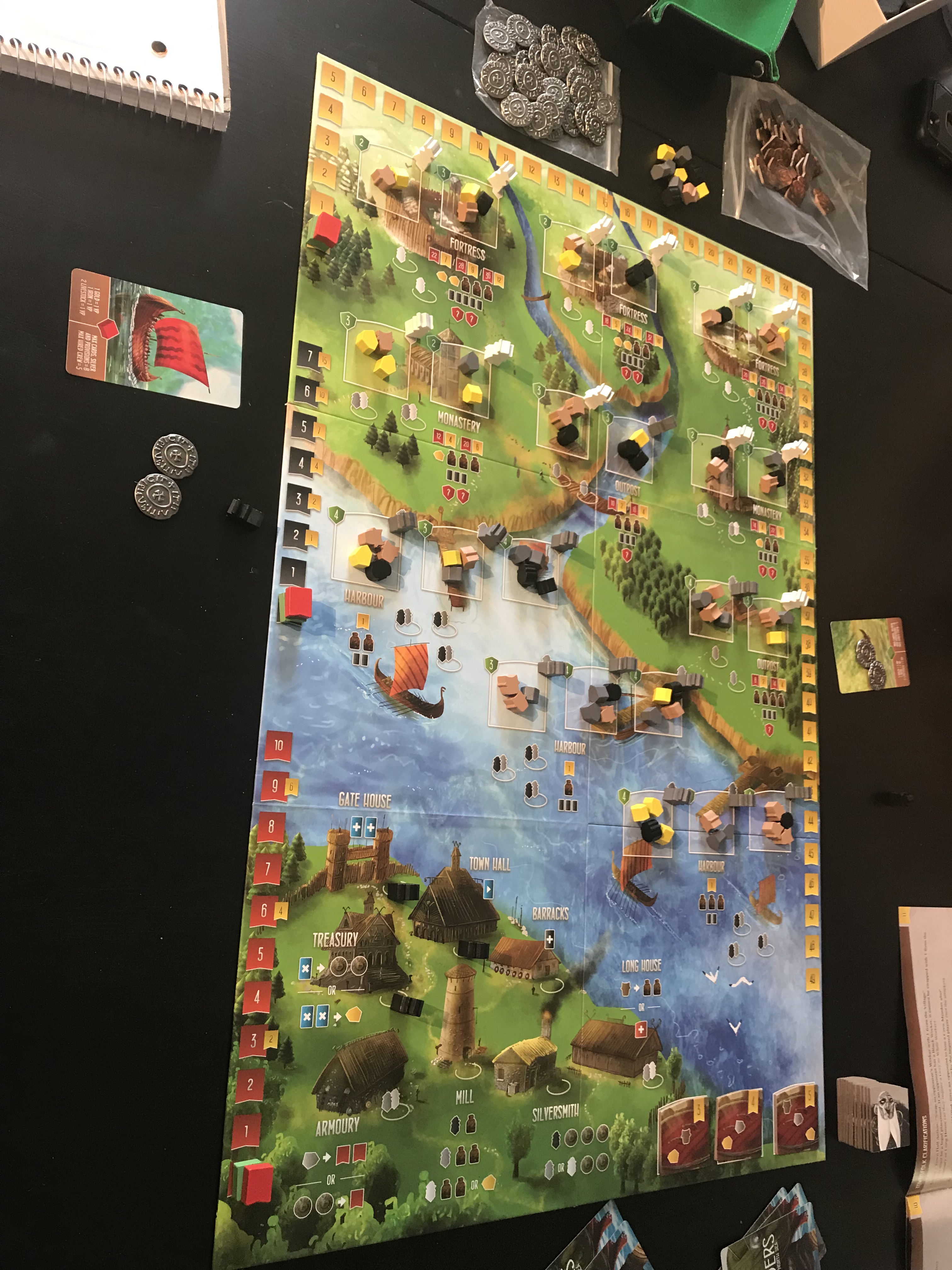
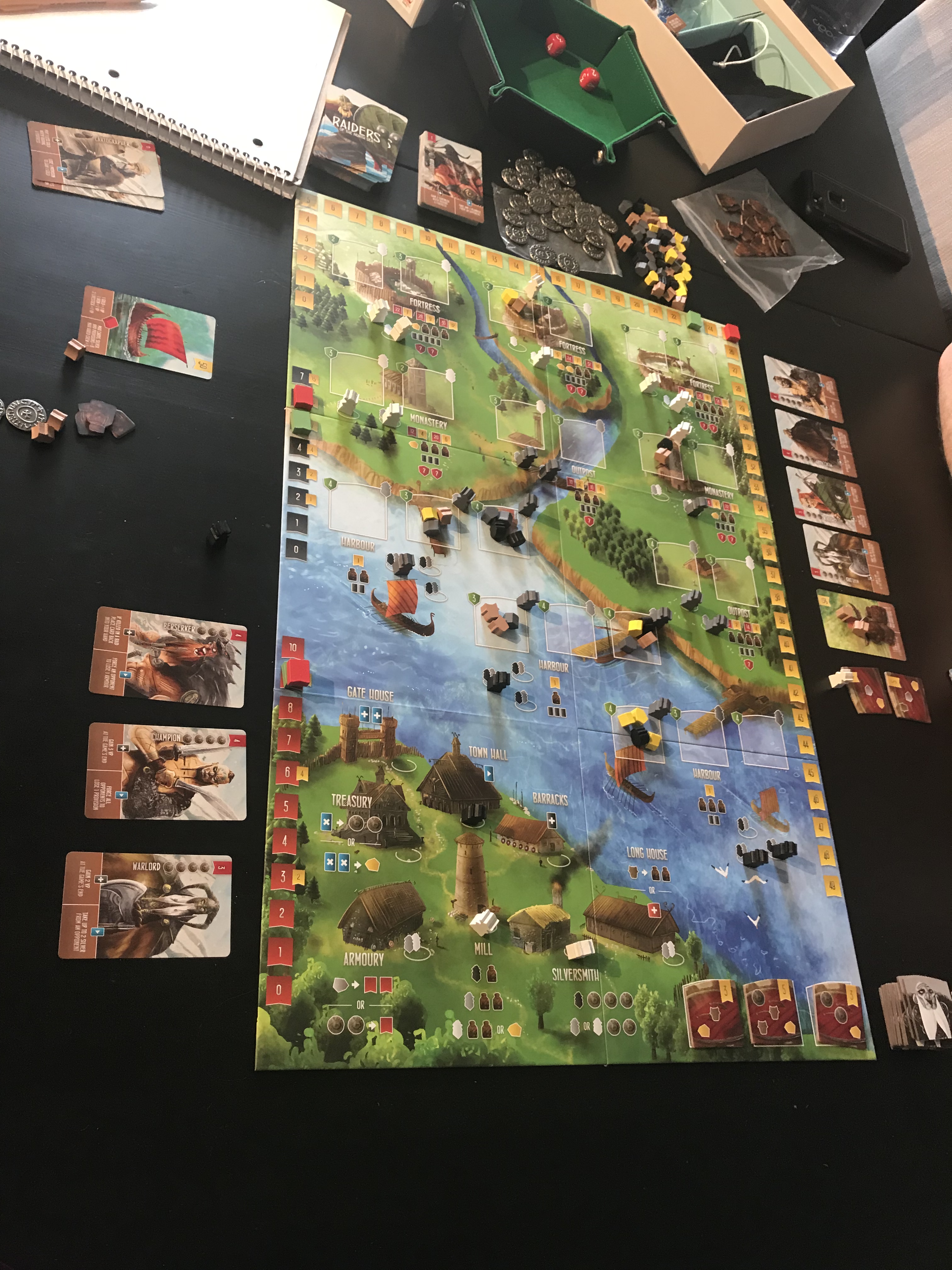
Empires of the North is a card based engine building game with asymmetric factions designed by Joanna Kijanka and Ignacy Trzewiczek and published by Portal Games. Empires of the North shares a mechanical structure with the other Portal engine building games, 51st State and Imperial Settlers, where the players set up an array of cards which they can use to gather resources to play/build more cards or do actions to get points. Empires of the North and Imperial Settlers look and play very similar with the exception of the common deck and the action wheel. Without the common deck, each player in Empires works off of their specialized faction deck. Each faction deck is relatively intuitive in relation to their predetermined complexity rating and a player can look at the cards in the deck and have a good idea of how to play each faction. How many factions are there? Six in the base game and there are two expansions with two additional factions each. Some factions may utilize similar mechanisms but each faction plays different enough. Some rely on the action wheel, some rely on building a huge array of cards, and, my personal favorite, some factions use a mechanism to store resources or workers on the cards in the array to gain more resources or cash them in for points.
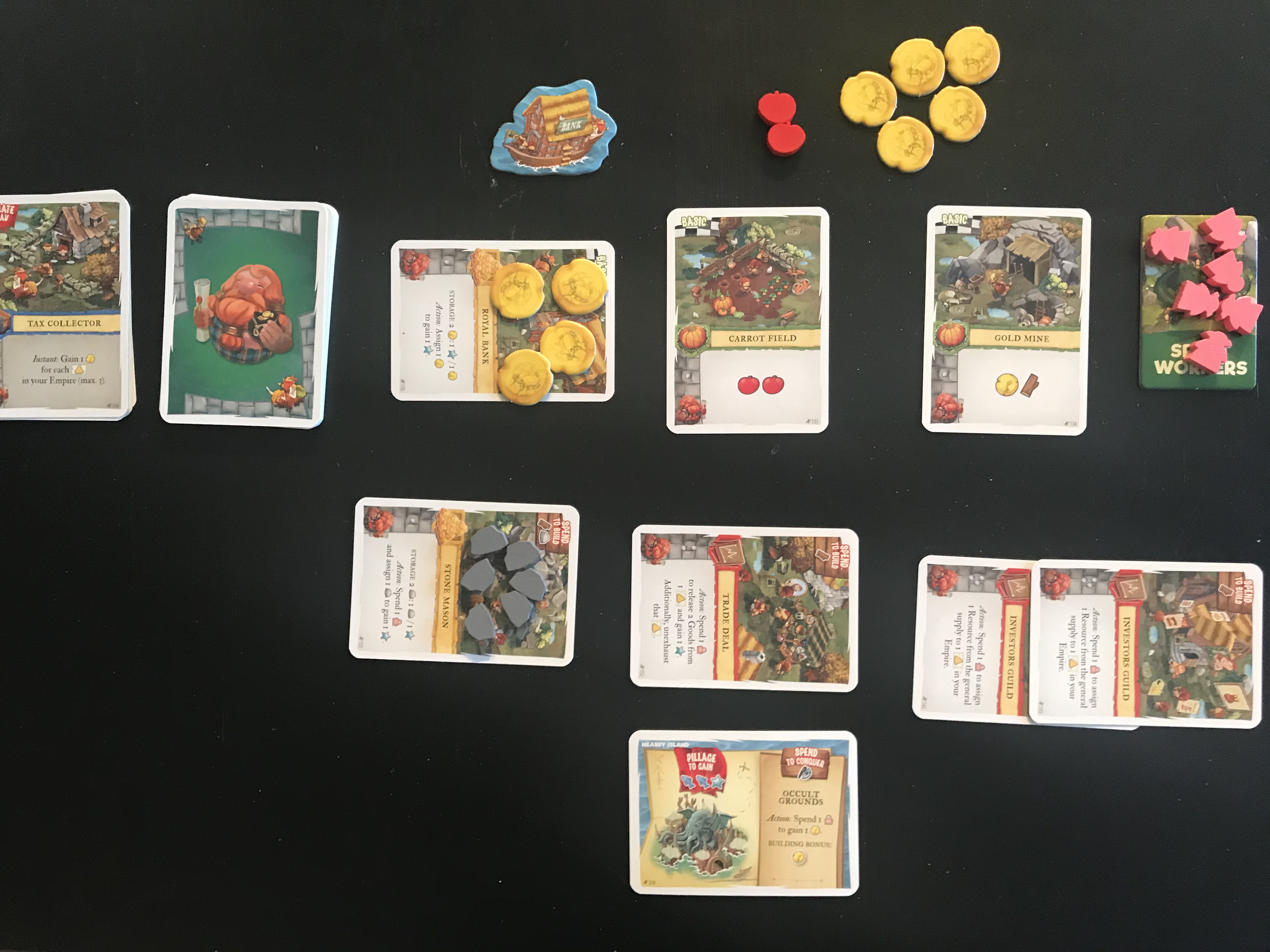
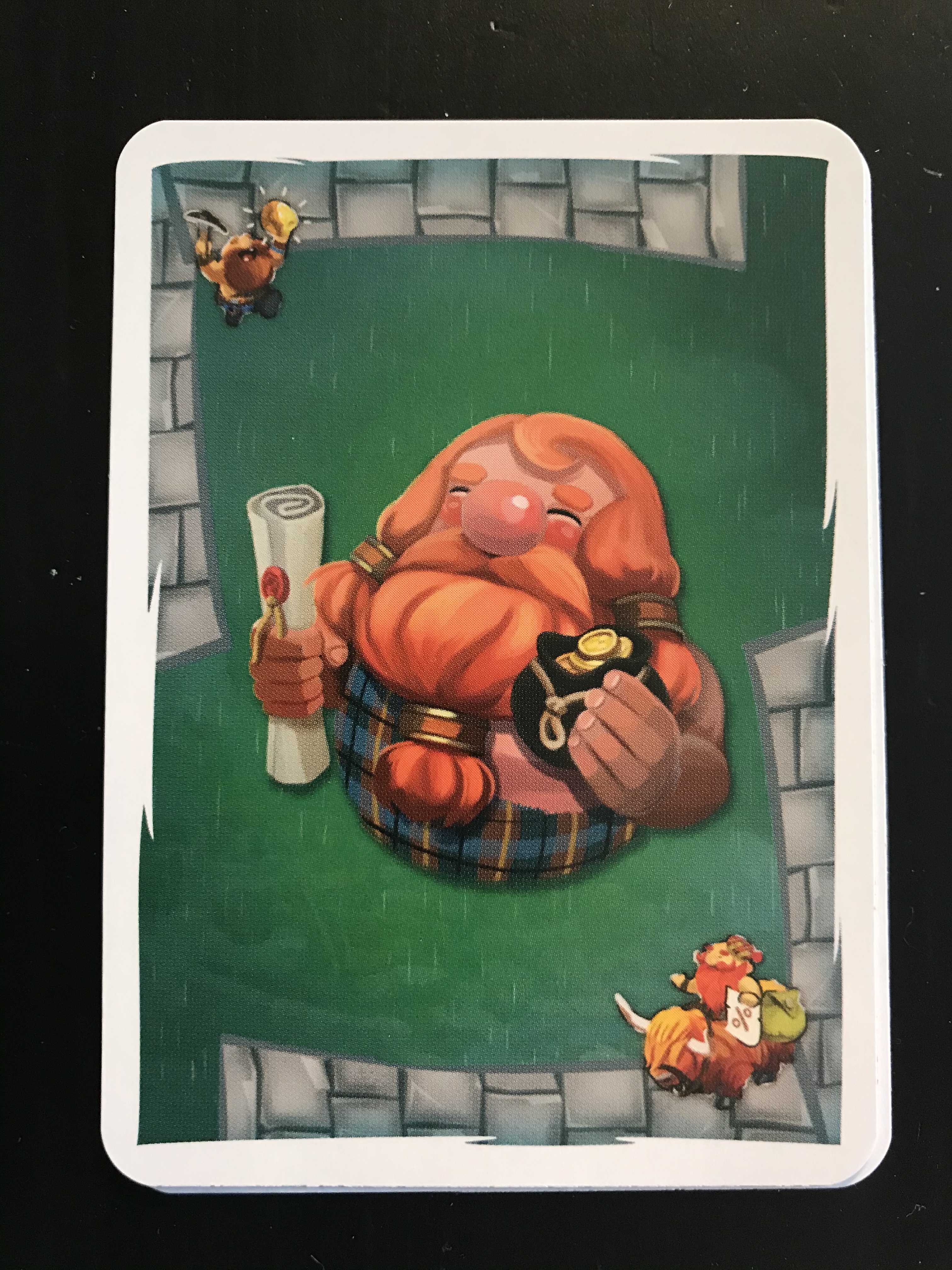
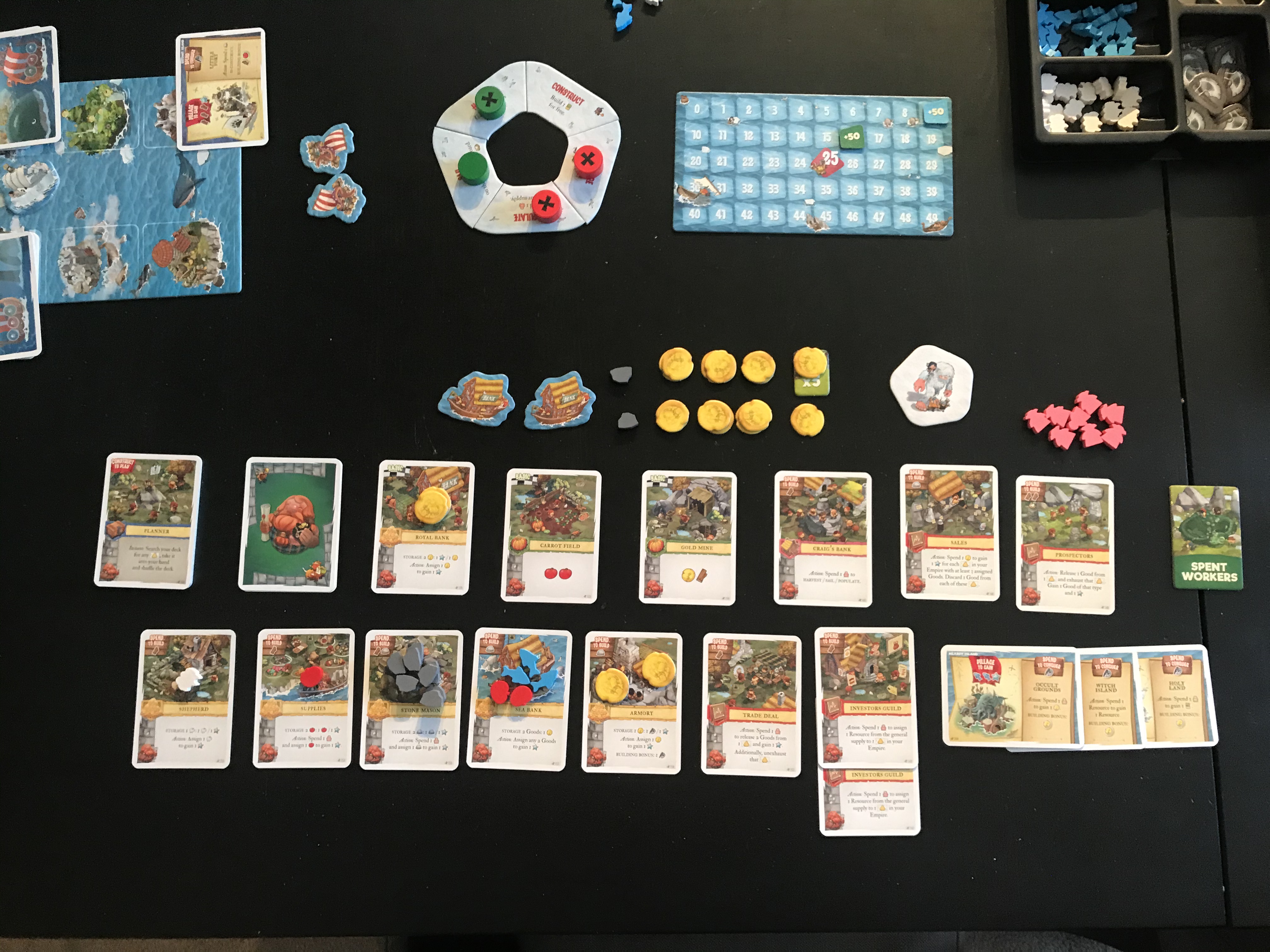
The engine building in this game is very focused unlike other card based engine building games which only have a common deck. In those games, there is the possibility of building cards for a particular purpose and never see another one of those cards you need for the rest of the game. Empires does not have that problem. Your next round will almost always be better than the round before it.
Empires of the North may be my favorite game of 2019, but it does have its problems. When it comes to card games like this, I like the game length to be less than an hour. I can see this lasting up to two hours with the full player count of four. I might play this with a total of three players if everyone has played before but, to me, this game really hits the spot at two players and a game can be about four or five rounds in less than 45 minutes. Although I do enjoy the art style, I can see players will have an expectation that this is a light and whimsical game with the cartoony Vikings and Scotsmen. It is not and if you are not ready for a mid weight+ engine building game, it will burn your brain. My last minor issue is that after multiple plays with the same faction, the player might go into autopilot and the subsequent games can feel a little too similar to previous games, but if Portal keeps supporting the game with future expansions to change the way the new factions interact with the game’s system, my minor issue will be averted.
Heather’s Best of 2019: Atlantis Rising 2nd Edition
I fell in love with Atlantis Rising 2nd Edition, published by Elf Creek Games, as soon as I saw the beautiful art, unique board layout, and exciting theme. Designed by Galen Ciscell and Brent Dickman, this collaborative press your luck, dice rolling, worker placement game is for 1-7 players and takes between 60-120 minutes to play. Players select an Atlantean leader with special variable player powers in order to collect resources and build a portal before Atlantis sinks beneath the waves. As the land tiles sink resources get harder to acquire and the pressure to complete the gate increases exponentially. It is a race against the increasing Wrath of the Gods, and approaching tidal waves.
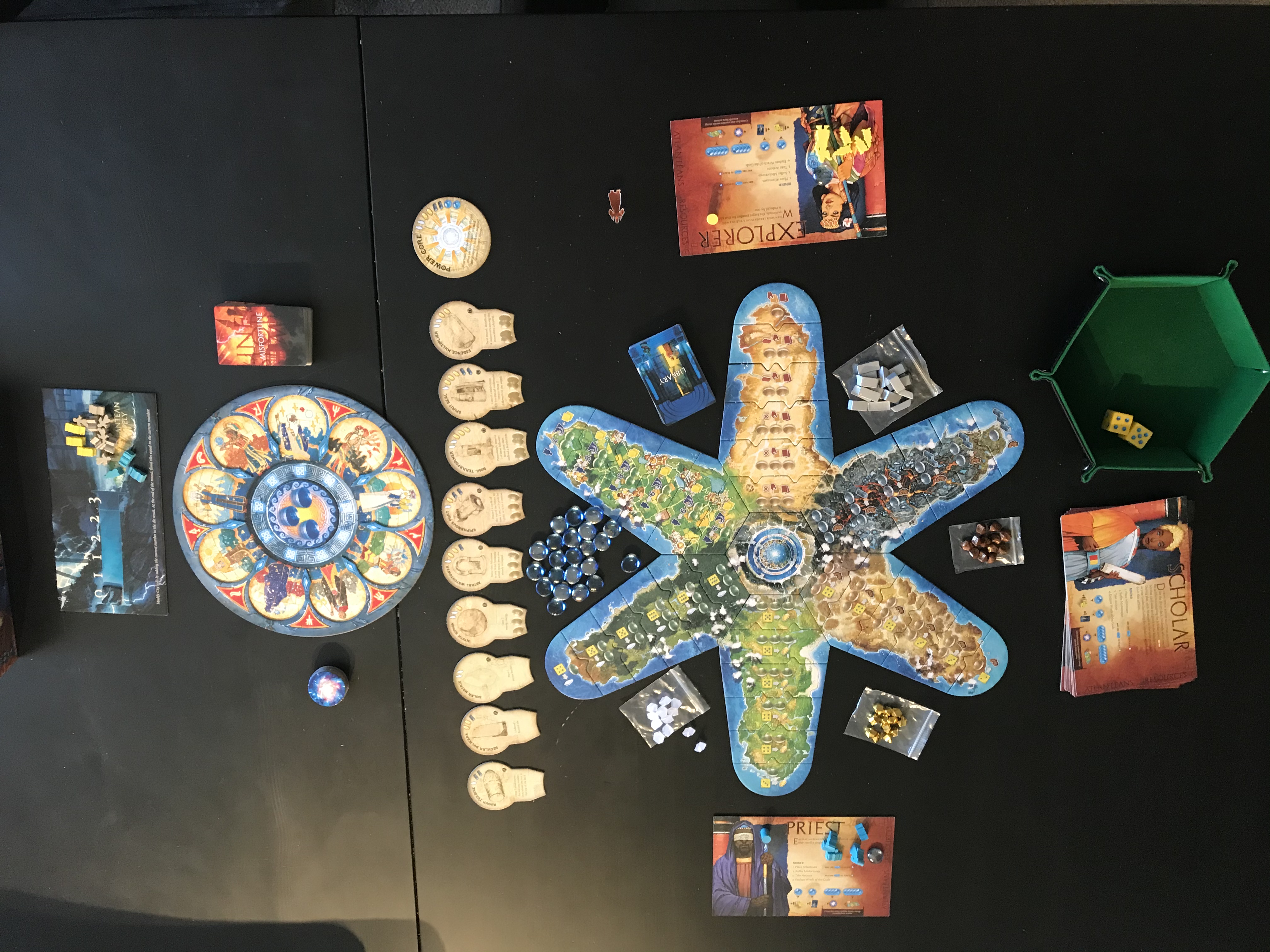


The production quality of this version is off the charts. The artwork by Vincent Dutrait and Peter Gifford is gorgeous. The resources are not just cubes and actually look like gold, crystal, meteorite and iron bars. The mystic energy, which can be used to increase die rolls, build barriers to prevent flooding, or unflood tiles, are shiny, heavy, iridescent blue gems. The board tiles easily fit together and are simple to flip over as the island begins to flood. The only complaint I have is one of our portal slots was glued crooked during production, so one piece does not sit flat against the board.
I must admit that collaborative games are my favorite type of game so I tend to gravitate towards them. This being said, everyone we have taught Atlantis Rising 2nd Edition to, has enjoyed the premise, mechanics, and wanted to replay immediately upon losing, or increase the difficulty and play again if we won. The game feels tense from start to finish. With every Wrath of the Gods phase, when the players choose what tiles of the board to flood, and during the misfortune deck, when events cause more flooding or setbacks, I held my breath. I never felt confident we were going to win, until we actually did. In fact, during one game, all the players had given up hope of succeeding and were surprised when we had another turn to try. Although the game play can take between 1-2 hours, it never feels like you are actually playing the game that long. That is how a collaborative game should feel.
As someone who plays a lot of collaborative games, I appreciate the variability and increasing difficulty levels. As difficulty increases, the gates require harder to acquire resources, and players have less bonuses in the Misfortune deck but the gate pieces provide better actions when they are more difficult to build. We have passed two of the five levels and welcome the challenges offered by levels three through five.
Gaining resources by rolling dice gave me instant gratification and a feeling of accomplishment. I enjoyed strategizing how to best coordinate the team’s workers and how to best utilize our player powers. When debating which pieces of the gate should be built first we considered resource availability and bonuses on the individual pieces. Some gave a one time bonus, such as unflooding a tile, but others provided an additional worker placement location, such as trading resources and gaining extra one time use volunteers during the next round. This element added an extra level to planning and more options, especially as the board began to flood and disappear.
As my household usually plays two player versions of the game, we tried out two different ways to play. For our first game, we played a four player version, with each of us controlling two sets of workers. We then tried out the two player variant and I was pleasantly surprised with how much I enjoyed it. In this version, players choose their permanent leader and special power but also have access to all the other leaders powers in the game through the hologram leader. Players take turns having the extra leader token, and utilizing the randomly shuffled remaining leader’s powers. At the end of the turn, the pawn is passed to the other player and a new leader’s power revealed. It is a great way to understand how all of the different leaders work, and creates a unique two player experience.
I can’t stop talking about this game. I have recommended it to several friends and constantly want to play it. I am thinking about playing it as I write this review. That is how much I love this game.
Joe’s recommended games of 2019

Marvel Champions – Arkham Horror LCG is one of my favorite games but Champions has a better pick up and play quality to it. It is still in its infancy but as more expansions are released and the system evolves, I can see my opinion of it improving.
Detective: City of Angels – I didn’t think the classic mode of this game would work but it has gone over so well with my primary game group. I don’t have the time to run roleplaying campaigns anymore, but City of Angels can scratch the RPG itch.
Watergate – Twilight Struggle is such a brilliant game with a few issues, a steep learning curve and long play time. Watergate is more intuitive and it plays in less than an hour. I still like Twilight Struggle more but I will be playing Watergate far more often.
Paladins of the West Kingdom – Shem Phillips has done it again. Paladins takes a system similar to Orleans and turns it up a notch. It is quite complex and there are many gears within gears but when the system finally clicks, gameplay is very rewarding. It also has one of the best solo modes in a game that wasn’t initially designed to be solo.
Heather’s recommended games of 2019

Obscurio – This is a semi-cooperative party game and as someone who loves Mysterium and Dixit, this game immediately spoke to me. I love deduction games with a traitor and this one did not disappoint. The game flowed fast, and everyone had a blast trying to decipher the visual clues, avoid the traps, and oust the traitor. My only issue with the base box is I wish there were more cards, which hopefully means they are working on an expansion very soon.
Fantastic Factories – As one of my surprises of the year, this independently produced game caught me off guard and is one of my favorite games of 2019. It is a fast, fun, easy to understand dice rolling, engine builder, with multiple paths to victory. The game seamlessly utilizes different mechanics such as worker placement, hand management, dice rolling, and card drafting, without feeling overly complicated or dull. I never felt cornered or far behind in points and enjoyed the high replay value.
Skulk Hollow – A beautifully designed asymmetrical two player tactical fighting game that plays like an RPG boss battle. Although I am still learning how to move my fox faction around the board, I enjoyed utilizing different leader special abilities and battling an array of monsters. The box includes four unique bosses and plenty of future challenges!
Trails of Tucana – One of my favorite purchases from our trip to Pax Unplugged and is a game I will always be up to play. This flip and write has variable modes, no one correct way to play, and plays within fifteen minutes. It is portable, fun, easy to teach, and has great replayability.
Other Games We Played from 2019
Ab Durch die Maurer*, Aquatica*, Cartographers: A Roll Player Tale, Copenhagen, Cthulhu: Death May Die*, Dead Man’s Cabal, Dizzle, Fire in the Library, Ishtar: Gardens of Babylon, Kingdomino Duel, Letter Jam, Mystery House: Adventures in a Box, Nagaraja, On Tour*, Paranormal Detectives*, Point Salad, Silver & Gold, Sushi Roll, The Taverns of Tiefenthal, Ticket to Ride: London, Twice as Clever, Wingspan
2019 Games We Haven’t Gotten to Yet
Clank Legacy: Acquisitions Incorporated, KOSMOS Adventure Games, The King’s Dilemma, Potemkin Empire, QE, Maracaibo, Medium, War of the Worlds: The New Wave
Bonus Bill Photos







 Greyt Games