


Raiders of the North Sea is a 2018 Mensa select family weight worker placement game created by Shem Phillips. This 2-4 player Viking themed game published by Graphill Games and distributed for retail by Renegade Game Studios combines worker placement, hand management, and set collection and plays in about 45-60 minutes. Using a unique worker placement system, players collect resources and Norsemen in order to raid further and further inland.
How to Play
Players start the game with 3 townsfolk cards, a player aid card, one black worker meeple, and 2 silver pieces. On their turn they place their available worker on an open location (paying attention to what is required to utilize the space) and take that location’s action. If they place their worker in the village they then choose to remove a viking meeple from a different village space and employ that space’s ability. If the player raids, they instead gain a worker through plundering and do not take a second action.
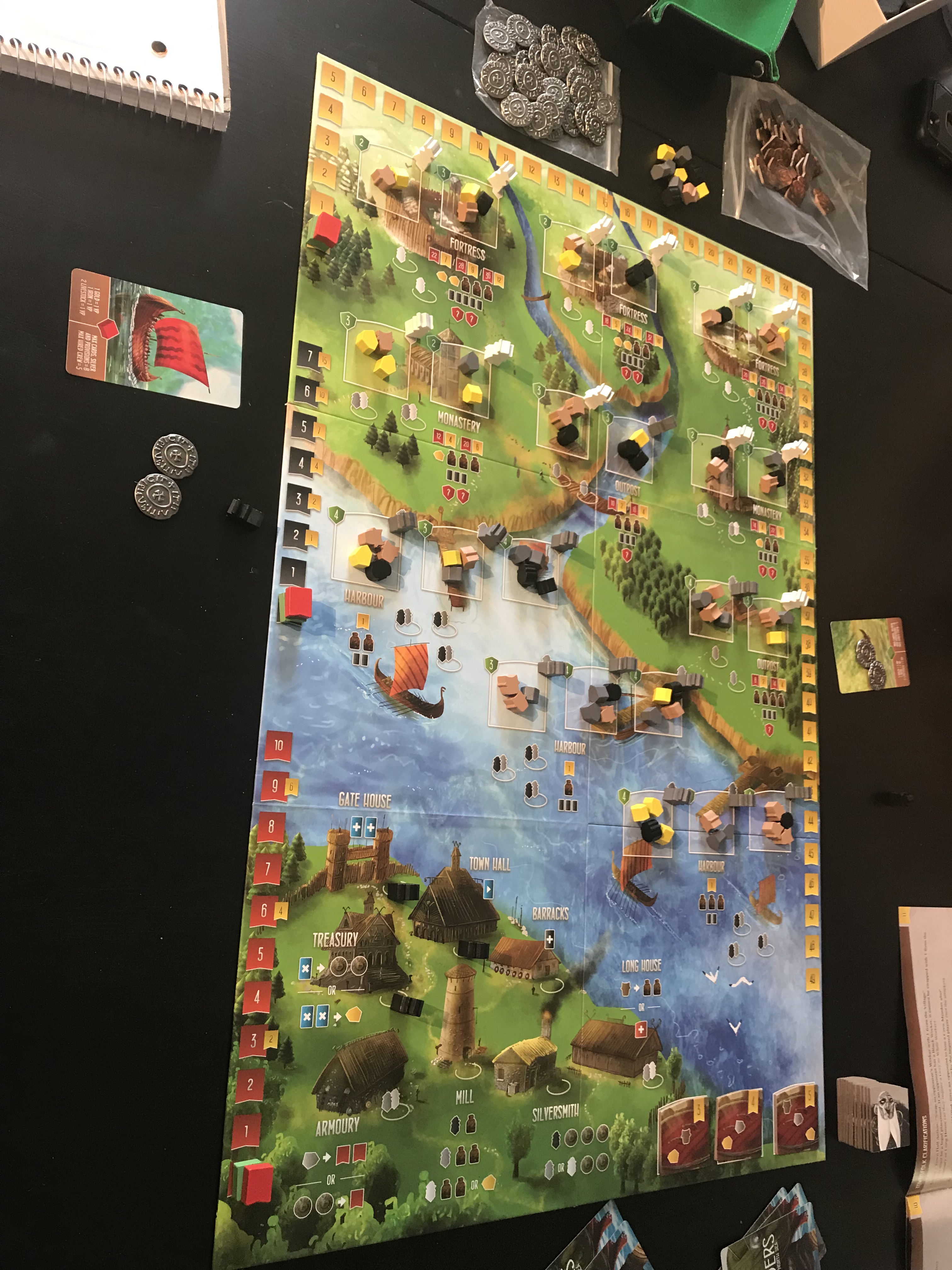
The first few turns center around the village, collecting resources and crew members. The available village actions are:
Gatehouse- Draw 2 Townsfolk cards from the draw pile keeping in mind hand limit is 8 cards.
Town Hall- Players play 1 Townsfolk card from their hand and use the card’s playable ability (ability under the play symbol). The card is then immediately discarded.
Treasury- Players discard 1 Townsfolk card to gain 2 silver, or 2 Townsfolk cards for 1 gold.
Barracks- Players choose a Townsfolk card in their hand and pay the silver indicated in the top left corner to add them to their crew. The card goes face up in front of the player and can be used during raids and their special ability (under the white plus sign on the card) used when applicable. A crew can not exceed 5 townsfolk but players may discard crew members to hire new ones.
Armoury- Using a white or grey worker exchange 1 iron for 2 armour (strength when raiding) or exchange 2 silver for 1 armour. The armour marker moves up the red armour track.
Mill- Using a black worker players gain 1 Provision, grey worker 2 Provisions, and a white worker 2 Provisions or 1 Gold. The max number of provisions a player can have in their personal supply is 8.
Silversmith- Using a black worker the player gains 3 silver and a grey or white worker 2 silver. Players may never have more than 8 silver in their personal supply at any given time.
Long House- Using a white or grey worker a player can exchange 1 livestock for 2 Provisions or pay the required plunder to gain an offering tile (along the bottom of the board) which are worth points at the end of the game.
Eventually players will have enough crew members and provisions to start raiding nearby harbours. Each location has a cost (certain worker colors, minimum number of hired crew, enough provisions, and sometimes gold). A player meeting the requirements of a raid places their worker, discards the appropriate number of provisions and gold, moves their score marker up the yellow victory track and takes one of the available loot squares. Possible plunder includes iron, gold, livestock, or Valkyrie. All loot is added to a players stash except the Valkyrie which requires the player discard a crew member, move their score marker up the black Valkyrie track, and place the Valkyrie token back in the main supply. When players raid, they receive a new worker from the raid and do not take a second action.
As players begin raiding inland their strength determines victory points. The red boxes indicate strength required to gain the victory points in the yellow boxes beside them. Strength is determined by adding up all crew member’s strength, hired crew special abilities if applicable, rolling one or two strength die depending on the location, and player’s location on the armour track.
Play continues until there is only one loot location left in the top Fortresses area, the Offering pile is empty, or all Valkyrie have been removed from the board. Players then add up their victory points, Valkyrie points, armour points, offering points, hired crew points, plunder points (1 gold =1 victory point, 1 iron = 1 victory point, and 2 livestock = 1 victory point). The player with the highest score wins the game.
Review
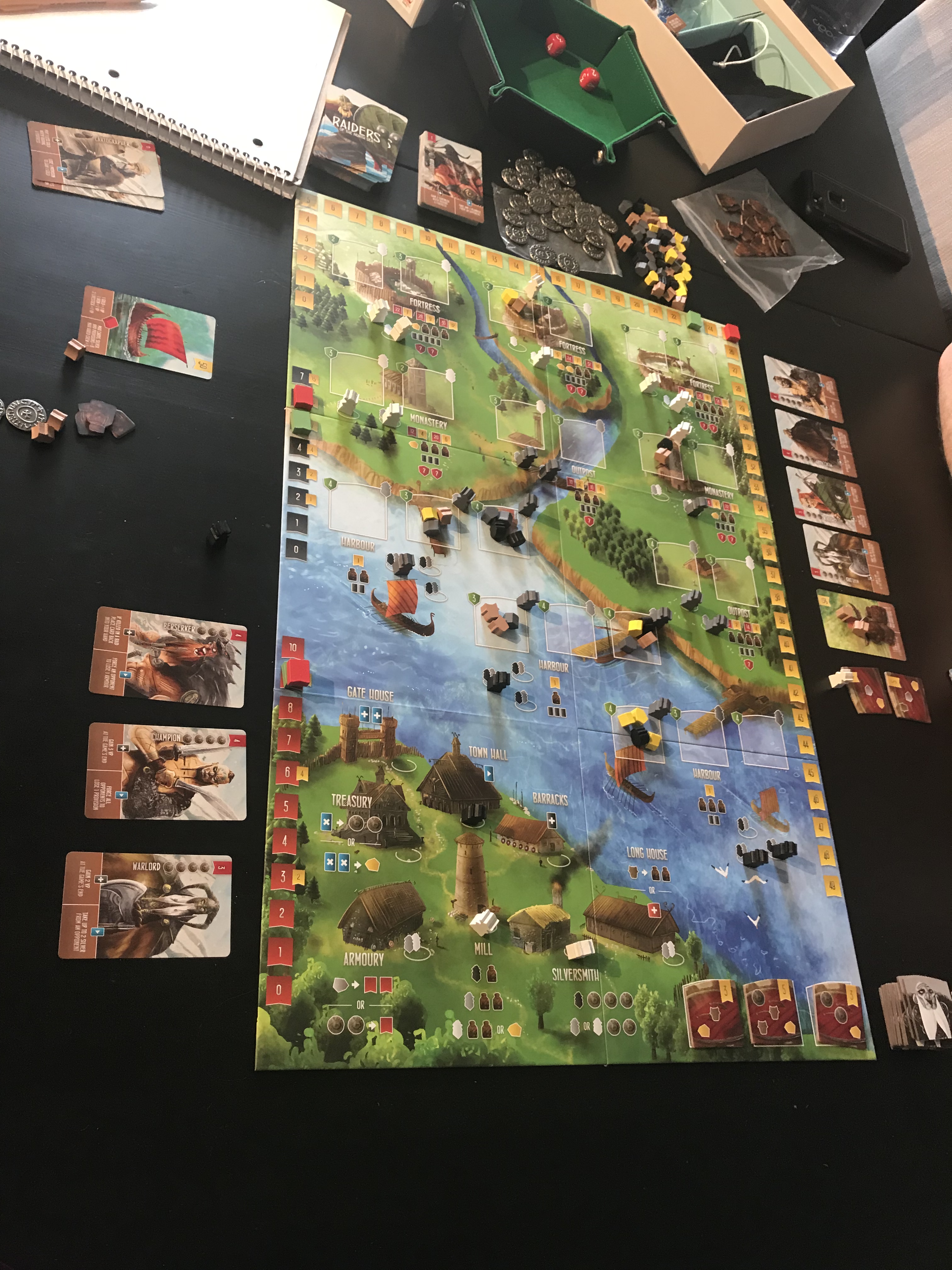
Although the box claims Raiders takes between 60-80 minutes to play we found it took significantly less time, especially after we got the hang of it. The most tedious part of the game is the setup. It takes a while, upwards of 15 minutes. The board has a very detailed, specific layout provided by a small picture in the rule book. Heather thought the image should have been much larger and not cut in half by the binding. She often had to squint to see what went where, and lost her place during setup. Some players may be put off by the extensive setup for a middle weight worker placement game.
Once properly setup though both of us thoroughly enjoyed the game. Yes, the theme could have been anything and vikings are often over utilized but in this instance it worked. There were multiple ways to earn points and we rarely blocked one another. Heather, who enjoys games with limited player interaction really liked this aspect. There are cards that allow players to steal from each other but we became so focused on our own goals, we did not utilize these abilities unless we had no other feasible moves. It did not seem worth it. A player could spend a turn taking one armour point from another player or possibly raiding an outpost. The reward for utilizing the card in other ways, such as hiring it as a crew member, was greater than discarding the card to pursue other players.
The first few turns are slow but the game quickly picks up steam and there is always something to do. With minimal downtime, players have to pay close attention and quickly plan their next move. The game has excellent pacing and players are left with feeling they want to do more. With so many paths to victory, players can focus on certain tracks or try out a more balanced approach without feeling left behind in victory points.
The production quality is extremely high. All of the artwork is eye catching, unique, and consistent. Besides the setup page, the rule book is well laid out, and iconography easy to understand. The components are mostly high quality. The board is a thick folded cardboard we worry may break eventually. Garphill has a new neoprene play mat, that is compatible with both of the Raiders expansions, and may solve this issue. All other components were impressive. The game comes with actual metal coins, unique shaped wooden tokens, and linen finished cards.
The game scaled well with both 2, 3, and 4 players games and setup and rules are always the same. Although the board layout and general gameplay is always the same, a common problem with worker-placement games, we do not see it becoming stale over time due to the various paths to victory. Yes, players know they will always start in the village, gaining resources and eventually raiding up the board, but where they will go and how they will utilize their available resources can alter each time. There are also two expansions, Fields of Fame and Hall of Heroes, we have yet to try, but have heard adds new quests, increases complexity, and introduces interesting mechanics to the game which may also improve on its replayability.
As a middleweight game, it may not be the best first foray into worker placement and not complex enough for those wanting a heavier worker placement game. To us though it was a great middle ground for Joe who enjoys longer, heavier games and Heather who enjoys lighter, quick ones. The game was a fast paced, unique worker placement game with a fun usage of the Viking theme.
Heather: 4/5 Paws
+ Low player interaction, multiple paths to victory, fast paced, easy to learn and teach
– Board setup hard to see in rulebook, long set up time, cardboard board
Joe: 4/5 Paws
+ Unique worker placement mechanic, minimal downtime, multiple player options and ways to get points
– Would prefer more complexity, extensive setup
 Greyt Games